 Akash Manohar John
My evening at Fracktal Works
I usually limit my blog posts to technical stuff. But this IMHO deserved one.
Until (Oct 18th) saturday evening, I knew about 3D printers as much as I know fighter planes.
Everyone around me had made 3D printers sound very complex. It only takes a while to understand and start working with it.
Ease of use of 3D printers
If you aren’t familiar with 3D printing, ease of use is relative to the documentation your 3D printer comes with.
There’s a myriad of details in the 3D printer. And the software that you useto print, needs to be made aware of the details of your 3D printer. Most of the configuration is one-time. But certain thing can be changed.
Nitty gritty details about your 3D printer
-
Most common 3D printing raw materials - PLA plastic and ABS plastic.
-
The base/plate they print on is called the “bed”. For most plastics the bed is heated to ensure that uniform temperature is maintained around the object being printed.
-
PLA plastic doesn’t require a heated bed. Most cheap 3D printers that you find in the market can only print using PLA plastic only. ABS requires a heated bed.
-
The pipe on top through which the melted plastic is transported through is a lubricated pipe (not explicitly lubricated, but the material which the pipe is made of is such). This is to ensure that the liquid plastic doesn’t halt anywhere in the pipe. That would cause a blockade.
-
There are other raw-materials you could use to print. Some require a very high temperature. In order to print using such materials, your 3D printer’s parts must be able to sustain the high temperatures.
-
3D printers have a maximum size they can print. Each printer has it’s own limitation. The Julia has a 10cm x 10cm x 10cm max print volume.
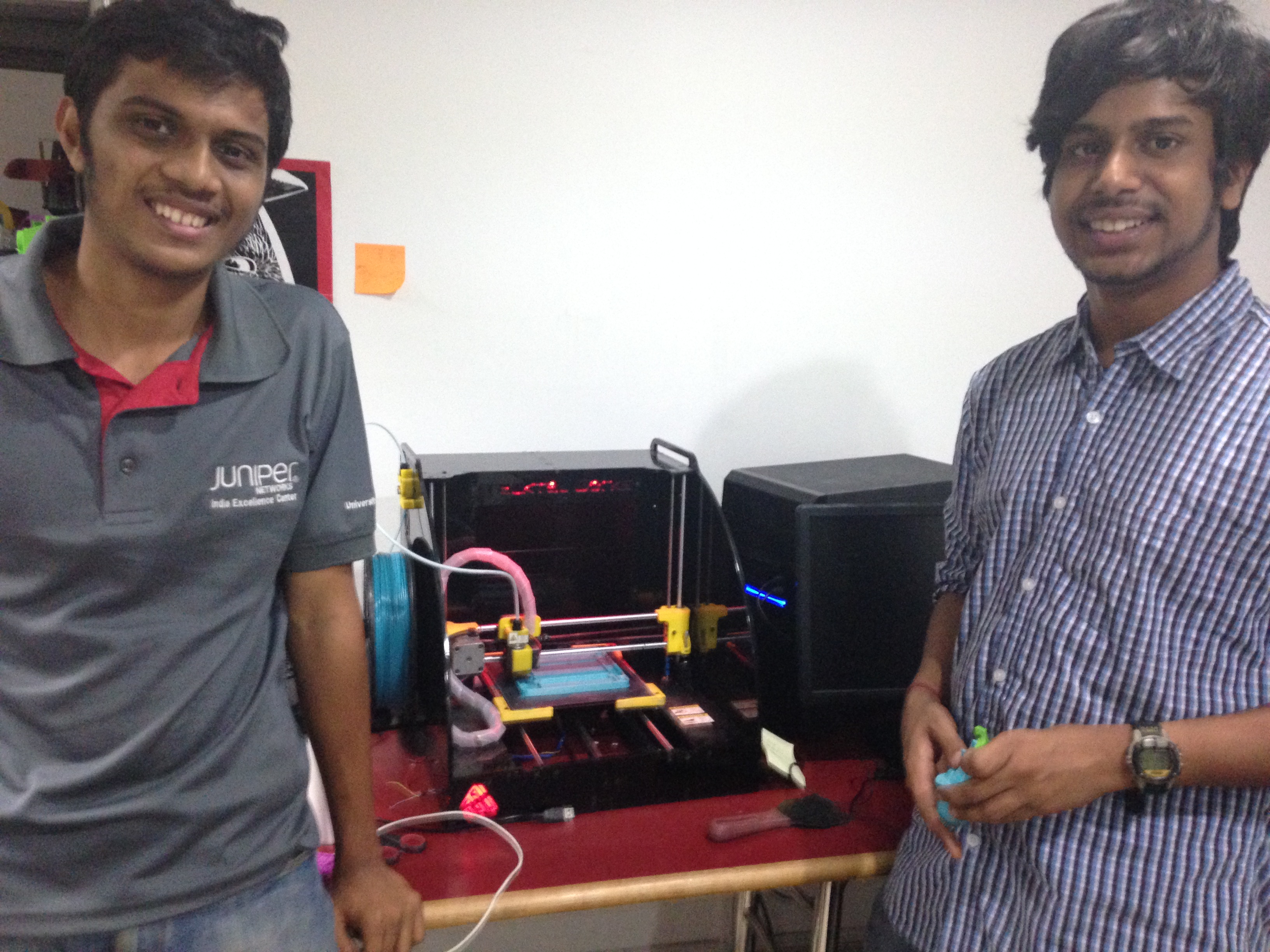
Photo of Vijay and Sumukh with the current generation of the Julia 3D printer